Today we’re going back to a topic that we’ve touched on a couple times on this show — the rising distrust of higher education, and what colleges and universities can do about it.
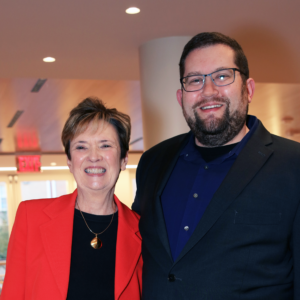
Today, I talk with Lynne Pasquerella, President of the American Association of Colleges and Universities, and Jeremy Young, their senior advisor for strategic initiatives. AAC&U recently put out a report called The Trust Agenda arguing that, to build trust, colleges and universities need to demonstrate that they are trustworthy. A key piece of the agenda is to build stronger and more collaborative relationships with surrounding communities. And, they say, we can find models for how to do this well by looking to community colleges and regional public universities where trust remains much higher.
Our discussion covers a lot of ground, from what fishermen know that researchers don’t, to the drawbacks of treating colleges as private commodities rather than public goods.
To Learn More
Read The Trust Agenda: A Framework for Advancing Public Trust in Higher Education
Visit the American Association of Colleges and Universities
—————————-
If you like this show, you can hear all the episodes and more at https://partnershipwork.org
You can also join our free Substack newsletter at https://partnershipwork.substack.com/
Partnership Work is an independent podcast, produced with the support of Urban Media Arts in Malden, MA. Visit them at https://urbanmediaarts.org/
The music for this episode was Hazy Reflections from the NFL Music Library on APM Music.
Paul Kuttner: Hey, welcome to Partnership Work, where we explore what it takes to move from isolation to action. I’m Paul Kuttner. Today, we’re going back to a topic that we’ve touched on a couple times on the show. The rising distrust of higher education, and what colleges and universities can do about it. Today I talk with Lynn Pasquerella, president of the American Association of Colleges and Universities, and Jeremy Young, their senior advisor for strategic initiatives. AAC&U recently put out a report called The Trust Agenda, arguing that to build trust, colleges and universities need to demonstrate that they are trustworthy.
A key piece of the agenda is to build stronger and more collaborative relationships with surrounding communities. And they say, we can find models for how to do this well by looking to community colleges and regional public universities where trust remains much higher. Our discussion covers a lot of ground, from what fishermen know that researchers don’t to the drawbacks of treating colleges as private commodities rather than public goods. I won’t spoil it all, here’s Lynn and Jeremy. Lynn Pasquerella and Jeremy Young, thank you so much for joining me on Partnership Work.
Lynn Pasquerella: Thanks for having us here. It’s such a pleasure.
Paul Kuttner: It’s great. Thank you. So we have a lot to talk about today. We are particularly going to dive into the report that you co-authored, Jeremy, and that AAC&U put out in June called The Trust Agenda, a Framework for Advancing Public Trust in Higher Education. So we’ll dive into what you wrote, But I really wanted to kind of turn it on you two just to start off with. So as individuals, just as people doing this work in and with higher education, why do you put your trust in higher education?
Lynn Pasquerella: Well, I certainly put my trust in higher education because it transformed my life. I was a first-generation college student. Neither of my parents graduated from high school. My father joined the war effort shortly after Pearl Harbor Day at the age of 16. And my mother got married at the age of 16, at a time when you couldn’t be married and stay in school. By the time I was 11, she was a single parent and was chronically ill, so I was a caregiver for her.
And at 17, when I was ready to go off to college, I had a full scholarship at my state’s flagship university. I made a decision to attend a local community college so I could continue with my family responsibilities. And I worked under CETA funds, the Comprehensive Employment and Training Act, 35 hours a week. I had Pell Grants and Perkins loans. And that experience opened doors for me. Two years later, I transferred to Mount Holyoke and then went off to Brown. But when I graduated, I left with a deep and abiding commitment to liberal education.
To access to excellence in higher education, regardless of socioeconomic background, and to political scientist Benjamin Barber’s notion of colleges and universities as civic missions, where we not only educate people to be free, but we free them to be educable by serving as a visible force in the lives of those who are most disenfranchised. I know the importance of that visibility in terms of creating access, which requires trust. In the system.
And so we do all that we can to ensure that we’re creating kinships, serving as anchors in our communities, which is absolutely necessary, to addressing the skepticism that people rightly have around higher education and the notion that it’s too expensive, too difficult to access, perhaps isn’t teaching 21st century skills. And we may indeed be bastions of liberal progressivism that are chilling certain voices. So I disagree with some of that narrative, and yet I am committed to taking seriously the real fears and concerns that people have that contribute to it.
Paul Kuttner: Right. No, I appreciate that background. What about you, Jeremy?
Jeremy Young: Well, I began my career, both academic and my professional career as a history professor, got a PhD in history, adjuncted and was a visiting professor for several years, and then spent four years teaching on the tenure track at what is now Utah Tech University in southwestern Utah. All of my teaching experience was either in red states or in red areas of swing States. For most of that period of time, I was teaching a 4-4 course load.
The last 18 months at Utah Tech, I took over a small institute of politics and public affairs that the university had started a couple of years earlier, and that became a portion of my course load. And that institute was housed within student services. The student employees were student government members. And so for part of my role, I reported to student affairs, the director of student affairs. And I really got to understand what the student affairs world and work was. And that was transformative for me because I had come up as a faculty member.
I had thought of myself as someone who was a writer first and a researcher first and a teacher to pay the bills. And I realized that the people who were doing the student affairs work were doing something that was absolutely vital for American society. They were supporting students in ways that I never could. As a faculty member, they were engaging with the community. I ended up serving on a strategic planning committee for a community engagement goal for the whole university and helping to write that goal.
And it just opened my eyes to the transformative effect that colleges and universities have on students and have on communities. And although I left teaching in 2020 and moved into the higher education nonprofit space. I have never lost that love of the system that is designed to open people’s minds and build connections.
Paul Kuttner: All right. Excellent. Thank you. I’m curious, coming a little forward, what were you hearing or what were you experiencing that led you to see trust in higher ed as a critical issue that you needed to address at AAC&U?
Lynn Pasquerella: We’ve been dealing with the issue of trust for decades. It was part of our founding mission in 1915 when campus leaders came together and talked about not only interconnectedness, but attempting to restore trust in liberal education as inextricably linked to our nation’s historic mission of educating for democracy. It was during the time of the rise of land grant institutions, and we wanted to make sure that we didn’t lose the focus of the good work that was taking place around liberal education.
More recently, under the Obama administration, when we put together A Crucible Moment looking at how to prepare students for work, citizenship, and life, trust was a central component of that work and has been part of our strategic plan since I started at AAC&U in 2016. Now, of course, there’s a new sense of urgency around this work because we have data showing a rapid decline in trust in higher education from 2015 to today, although that’s rising a bit. We know that this is happening across all sectors. And so it’s not unique to higher education.
Paul Kuttner: Maybe I’ll turn this to you, Jeremy. You’re talking about trust. And I think we do need to define our terms a bit here. The way that the report talks about the decline in public trust in higher education, trust is not maybe the way that we all use the word trust. It seems very relational. It’s very much of, it’s defined actually as something that exists within a relationship. Can you talk about what we’re, what we mean when we say that trust is declining?
Jeremy Young: That’s exactly right. You know, we, we, sorry, I’m realizing just now that I need to have this report pulled up so I can quote from it because you’re going to need a quote for this. Just give me a moment. Here it is.
Paul Kuttner: Did you not read the report? You should check it out. It’s really good.
Jeremy Young: I know. It’s really good.
Lynn Pasquerella: It is quite different from reading it.
Jeremy Young: Right. I’ll get there at some point. I’ll take a look. In the report, we define public trust in higher education as a dynamic of the relationship between colleges and universities and the public. We say institutions and their representatives foster public trust by demonstrating their trustworthiness consistently through effective actions that promote the public good. And that is fundamental to our understanding of trust. There has been some discourse lately that I think is really counterproductive that suggests that trust is not a value that higher education should be investing in or that there isn’t a trust deficit.
You know how I know there’s a trust deficit because after everything that has happened with the administration in the last 18, 19 months regarding higher education, there hasn’t been any significant pushback from the public about this. You go to a protest, you’re not seeing signs saying hands off our universities. You’re not seeing politicians who make a priority of attacking higher education. Face any sort of electoral consequences for that in the way that you do say at the K-12 level with book bans, school board members are being turned out for banning books. We don’t see that at the higher education level.
So we know there is a trust deficit. And we know that what that means is that trust, that the public doesn’t see us as a community asset. That’s how we’re really defining trust. And it’s not just that higher education, it’s more complicated than what I just said, because actually, the public does see most institutions of higher learning as community assets. There is good data that suggests that regional public universities, community colleges, which together support over 80% of students in the country, are very highly valued by their communities.
But when the public thinks of higher education, they have this sense of a remote, extractive, elite institution, perhaps in the New England area that is taking students out of their communities and they never come back. That’s what people think of when they think of higher education.
And so part of our argument in this report is that to restore trust, we need to change the balance of how we talk and think about higher education so that we focus primarily on the institutions that, are down the block from you, the institutions that everyone can see that are clearly and obviously working in the community. It’s not an accident that we began the report with a profile of a community college in Boston.
That is central to our message, that institutions that support the community, that demonstrate they are community assets, are the institutions that we need, to model and to reverse engineer and copy if our goal is to restore or advance public trust.
Paul Kuttner: I want to come back to the sort of community college regional piece, but I wanted to ask you, Lynn, to jump back to something you were just talking about. So AAC&U, you’ve been working on trust in liberal education for over 100 years. So that’s been a part of a struggle this entire time. And I know now it’s different now than it was, certainly. The pressures are different. But do you have a sense, like, what has higher ed done in that time that has actually worked in terms of strengthening its relationship with the broader public?
And are there things it’s been doing during that time that haven’t? Because clearly that problem hasn’t been solved.
Lynn Pasquerella: We have, For decades, existed within an ivory tower as a willful disconnect from the practical matters of everyday life. It was part of what a liberal education was for. You liberate your mind from past dispositions. You go into this pastoral retreat and you think and prepare yourself for the life ahead. There was a focus on creating lives of meaning and purpose. And then we know in the 60s with the corporatization of higher education when universities were focused on on research. There was less of an emphasis on teaching and preparing students for citizenship and life.
And now, of course, we’re at a time when we’re attempting to measure the value of colleges and universities solely in terms of immediate employability and average salaries earned. So, liberal education, particularly the humanities, are a tough sell these days. So, different moments in history have led to different challenges for liberal education. And we view this as a moment of extraordinary opportunity. Yes, the headwinds are strong and the challenges are greater than they ever have been. But there’s also a sense of hope and optimism about creating a system that really is equitable. It meets the equity mandate before us.
Paul Kuttner: I want to move to your recommendations. So you have five recommendations in the report. Accelerate innovation. Prioritize community engagement. Recommit to inclusive, excellence in a really kind of student-centered, open, welcoming way. Tell a clearer story. And then coordinate a mission-centered defense of higher ed. So we don’t have time to go into all of those. I really want to focus on community engagement first. And tell me a bit about how that ended up in there. How do you see community engagement as a key pillar in this work of rebuilding trust?
Jeremy Young: There were a few inputs that led us to the focus on community engagement. One is just the data showing that community colleges and regional publics are so much more popular and well-liked in their local communities than other institution types. But another factor, was a report or a book that we read, our team read, by Kathy Cramer called The Politics of Resentment.
The book came out in 2016, but most of the research occurred in 2007 and she interviewed a number of, loggers and people living in rural northern Wisconsin and just conducted qualitative interviews with them and asked them what they thought about the University of Wisconsin. And it’s a really useful data set because it is, you know, 2007 was before there were any major national or even state level politicians making, you know, critical comments about higher education at the level that we see today.
Even in Wisconsin, Scott Walker was a couple of years away, and yet she found significant distrust among the public. So it was clear from this that it’s not, you know, this is not something created by political figures in Washington, D.C. This is something that is real, at least at some level, at least a kernel of it is real. And what those people talked about in the book is just a feeling of remoteness from the institution.
So there’s this great story where a guy tells her, you know, I was fishing up at the fishing hole where I’ve been, you know, me and my friends have fished for our entire lives. And we encountered a University of Wisconsin scientist there and we asked him what he was doing. And he said, I am trying to determine whether bass spawn in the same place every year. And the man became very angry and he said he didn’t ask me. He didn’t ask any of us. We could tell him the answer. We’ve lived here our entire lives.
And he says they just don’t care about you. They don’t want anything to do with you. And that was really telling. That wasn’t the only story in that book like that. You know, we are our feeling is that in order for, you know, our real goal here is for the public to come to the defense of higher education when it’s under threat.
The public needs to see higher education in the way that they see the fire department, you know, as something that is community serving first, that is clearly invested in, the publics that it serves, which in the case of large selective institutions, may not only mean its local community, but also the communities that students call home. And that positions itself in the way that the fire department does as a helping institution, as a community asset. And we looked at that and we found that, you know, a number, of course, community engagement is not a new idea.
The Campus Compact was signed over 40 years ago. But what is needed is a sort of universality that simply doesn’t exist. For this to be central to the missions of institutions across the country and institutions of all types. We live in a media environment where someone doing something on one campus goes into the TikTok machine and people are seeing it all over the country, and they’re assuming that’s what higher education means. So it’s no longer enough for community engagement to be a coalition of the willing.
It needs to be uniform and universal in a way that it hasn’t been in the past.
Lynn Pasquerella: And of course, that vision that Jeremy just outlined would require upending our current reward structures in higher education. Our current system rewards peer-reviewed journal articles, grants received, but not engagement in the communities in which we’re located. And Hunter College President Nancy Cantor has long talked about the ways in which being an anchor in one’s community requires that we demonstrate that our success is inextricably linked to the psychological, social, economic, educational well-being of those in the communities in which we’re located and those we seek to serve.
So she enjoins us to stop telling people what we’re good at and instead begin asking them, what are we good for and what do you need from us? And in doing so, become co-creators of knowledge. Take advantage of local epistemologies to Jeremy’s point of this compelling example. The members of the community know answers to some of the questions that we’re spending millions of dollars asking their legitimate questions. But let’s take advantage of our local communities. And in that way, we can restore trust.
Paul Kuttner: So what does it look like to have a more universal approach to community engagement in higher ed? Do you have examples that you really like to share?
Jeremy Young: Well, one example that we used in the report is the University of Texas at Arlington, Jennifer Cowley’s incredible work there on community engagement. You know, it’s a useful example because it is an institution that you would not expect would be able to be community engaged. It is in a red state. It is a research one institution. Both of, you know, if you ask the average person on the street, you know, are the institutions like that engaged in the community? They’ll say no. So this institution became so thoroughly mission-driven to community engagement. It started with their strategic plan.
They wrote a strategic plan where the entire plan focused on community connections. They created numerous offices and projects. They created incentive and reward structures, as Lynn mentioned, to build tenure and promotion recommendations to encourage faculty and staff to support community engaged work. They work with students to build community engaged projects. They even got a grant to create a fleet of autonomous self-driving cars to convey people around the city of Arlington for free. You know, just completely embedded in the community.
And when President Cowley talks about this, she says that her strategy for making sure that the campus is community focused is to begin with yes. When she hears an idea from someone, rather than starting with, you know, here are the problems, here are the obstacles we’re going to face. She doesn’t agree to it automatically, but she immediately begins trying to figure out how it can happen. And if it’s at all feasible, she’ll greenlight it. And that has led to this just proliferation of community engaged work. What’s…
Critical with that example, and what’s so different from a number of other Research One institutions that have struggled with community engagement, is that they’re not siloing the work in one office. They are, you can’t walk around, you can’t be a faculty member, you can’t be a staff member or a student at UT Arlington and not know that engaging with the community is the central mission of the university. And, you know, I think a number of institutions have built incredible community engagement programs and partnership offices. But you ask your average faculty member, what’s the mission of the university?
They’ll say, well, the mission is to do groundbreaking research for a national audience. And they’re just very remote from their own office on campus. And I think that’s where some of these efforts have foundered. Of course, we don’t see those problems at community colleges, regional publics, most HBCUs, TCU.
Paul Kuttner: Why not? What are they doing different at those kind of places? And, you know, speaking as someone at a regional public university, I love hearing it, but.
Jeremy Young: Well, it’s an interesting question because I had a conversation with a president at a community college system about a year ago. And I said, why is it that the community thinks that you are a community asset when clearly you don’t have an enormous marketing budget? Your marketing budget is spent on maybe getting into a couple of high school classrooms and recruiting students, but you’re not putting up billboards. You’re not running television ads. How does that message get out there? And she said, there’s simply nothing else that we do.
You know, it’s obvious to people that this is our entire mission because every single thing that we do is community engagement. You’ll never encounter someone at a community college who is doing something other than community engagement in any context. And that, I think, is very similar to the situation the fire department is in. What happens when you encounter firefighters? They’re putting out fires. They’re saving cats from the tops of trees. They’re holding toys for tots raffles. You know, there is there is nothing that you see them doing that that is counter to that mission.
So it is the mission alignment that we see in these regional institutions and local institutions that is different from what we see elsewhere.
Lynn Pasquerella: They’re often the largest employer in the region, and that’s true of all types of institutions. But the people who are working there and the students who are studying there live in the community. They are invested in the community in ways that other student populations aren’t.
Paul Kuttner: One thing that I definitely felt throughout the report was this really putting the onus on universities to change. And you talk about this idea of trustworthiness. And I think in community engagement and community partnership work, that’s coming up a lot more. Shifting from the language of trust sort of implies that. If I give you enough PR, if I give you good pictures of what I’m doing, you’ll trust me. And this idea of being trustworthy, earning that trust.
So can you talk a little bit about what higher ed really needs to do to be trustworthy for communities that are very skeptical of it?
Jeremy Young: You know, the challenge of trustworthiness is the challenge of longevity. That is really, in order to be trustworthy, you have to make promises and keep them over years and over decades. And that’s particularly challenging now because the tenures of college and university presidents have become so short. The average tenure is under five years now. And so really, you can’t accomplish the building of a trusting relationship with the community in a single presidency unless the president is extraordinarily long tenured. You need to have some continuity between administrations.
And that’s something that we’re hoping to see more of from institutions, even if they’re – and it’s challenging. One of our recommendations focuses on innovation, being able to accelerate the pace of change. It’s important that that change not be at the expense of long-tenured relationships in the community because that does undermine the value of that trustworthiness. And just to follow up on Lynn’s excellent point about being visible in the community, you know, being visible in the community requires the participation of everyone involved in a campus.
You know, the faculty members, students, trustees, staff members, alumni, all of these people, you know, the president is probably the single most visible person in the university to the community. But the faculty as a whole are far more visible. The staff as a whole are far more visible. Chances are, especially if it’s a smaller community, you have somebody who works at the university living or who attends the university living on your street. And so these local individual interpersonal interactions need to be mission aligned.
And the only way that that can happen is if the university builds internal trust in addition to external trust. We have to give the constituents of the university, including the students, who some polling indicates become less supportive of their institution as they spend more time in the process of getting a degree. We have to give them a reason to believe in the mission. And once we’ve done that, then we can deploy them and deputize them to spread that mission to the public.
Paul Kuttner: One more type of trust I want to throw out and see what you think. Are there ways in which higher ed institutions need to trust the communities that they’re engaging?
Jeremy Young: I think that’s a great point. Yes, of course. And that’s, you know, that’s exactly what that example of the fishermen, the bass fishermen points to, that there is local and community ways of knowing that are not being taken advantage of by institutions. And that’s the low-hanging fruit, really. It’s easy for institutions to stop showing up and saying, I’m here to fix your problem, and instead say, tell me what you know, and I can learn from you, and then we can work together to find solutions.
That’s just, it’s an easy move to make, but it’s something that needs to be internalized throughout the process of building institutions, through the process of training faculty and staff, through the process of incentives, and so on.
Lynn Pasquerella: And it requires us to adopt a stance of intellectual humility.
Paul Kuttner: Can you say more about what that means?
Lynn Pasquerella: It means understanding that the approaches that community members might have to solving our shared problems might actually be better than the ones that we’ve adopted. I was for five years led a research project in Kenya looking at clean water solutions, sustainable agriculture and entrepreneurship. And our students spent a couple semesters, students from Brown, MIT, University of Hartford, University of Rhode Island, working on designs for the most effective kiln for clay pot water filtration.
The women in one of the communities we worked in took some local grasses, leaned up against them, created a kiln that was much more effective than what it took my students two semesters to do. It might have occurred to us at the beginning of this project to ask them before we spent all these resources.
Paul Kuttner: What about institutions, you know, we’re talking about general distrust, but what about places where sort of significant harm has been done? You know, Lynn, when you’re talking to presidents and people at institutions around the country, like, are there specific ways of thinking about trust when there’s very particular harms that have led people to distrust and be skeptical that higher ed has their interests in mind?
Lynn Pasquerella: Yes. Well, you have to accept accountability, apologize, be transparent. And the challenge for presidents today is that there are multiple constituencies often calling for resolutions in ways that issue unconditional non-negotiable demands. And yet the demands are at odds with one another. So not everybody is going to be happy with a decision that’s being made, but you must be transparent around how the decision was made, whose voices were heard, whose were marginalized, and then talk about the real impact of those decisions. What’s the disparately negative impact of certain decisions?
What burdens are being borne by certain populations that might not be transparent in the way that it’s being communicated.
Paul Kuttner: Jeremy, when you were looking at, actually looking at the data on distrust, are there particular communities or groups within the country that have more or less faith in higher ed? And do you have a sense of why?
Jeremy Young: So the polling suggests that there has been a big fall off in trust in higher ed And among Republicans in particular, starting around the beginning of the first Trump administration, so 2015, 2016, There has been some decline among independents. What’s interesting is that over the last year, the new Gallup poll that came out that asks this question every year found that there has also been a decline among Democrats. And the suggestion is that that decline has some relation to how universities have responded or failed to respond to the actions of the current administration.
In other words, they are not inspiring confidence or trust because they’re not defending themselves in the way that the public would like to see. Even the Democrats would like to see. Beyond that, we don’t have a lot of demographic data of different groups of people. Of course, people who’ve been to college and received a degree tend to trust higher education more than people who haven’t. Although actually that data as well has shifted a bit. It is now only people with graduate degrees who have more trust in college than the general public.
People who have received only a bachelor’s degree have the same amount of trust in higher education as people who have some college or no college experience. So it really, you know, there is a group of boosters for higher education, typically people who are very involved in the higher education system. The farther away you get from that system, the less popular it becomes. But really, that points, I think, to a challenge with not just a particular group, but with the public as a whole.
You shouldn’t have to reach out and touch higher education in order to understand what it does for you. Again, going back to the fire department example, most people never call 911. Most people never have a fire, but they understand the value of having a fire department in their community. And that is something that we need to change for higher ed.
Lynn Pasquerella: Yeah, it’s one of the consequences of the shift away from the notion of higher education as a public good to viewing it as a private commodity. There is skepticism about the value added of a college degree and return on investment. And I think that’s part of what’s fueling the narrative.
Paul Kuttner: You put this out in June. What has been the response from higher ed, from people outside higher ed to the report? And I assume you going around the country and sort of sharing these ideas in other forms.
Jeremy Young: So we’ve gotten a lot of a very large number of readers and views for the report. So people are reading it, they’re listening to it, they’re paying attention. We had coverage in all the major higher ed publications when it came out in the Washington Post and the Atlantic and some other places. And since then, it’s interesting the way the trust conversation has evolved into – there are these other reports from Yale and Vanderbilt that have focused on trust in different ways from how we addressed it.
And the administration has been seizing on those reports and saying that this demonstrates that the administration’s priorities are the reason that the loss of trust has occurred. And we are trying to make, I think, a very complex argument that isn’t obvious to, that doesn’t fall along obvious political lines. We are arguing that there is a serious trust problem for higher education, but that it doesn’t map very closely at all onto the administration’s concerns, that the concerns of the bass fishermen are very different from the concerns of the person the bass fisherman votes for.
And we need to understand that public level of concern and that community level of concern and address that. I think we have had a real strong wave of support from frontline practitioners who do community engagement work, who do student success work, who see us as advocating for. You know, that the type of work that they do is no longer a nice to have. It’s no longer optional. It is central to solving this problem that higher education faces. And so we are continuing to promote the ideas and the recommendations of the report.
We are starting a leadership institute in January that will have campus teams come and work with us to implement those recommendations on their campuses. We are building a coalition. We’re starting the process of building self-assessment metrics for campuses to evaluate trust. So really, I think the strongest response has been from people on the front lines, people who are engaged in this work and doing this work and see this, as a new way of thinking about the problems and possibilities of higher education.
Paul Kuttner: Lynn, did you want to talk about what you’ve heard?
Lynn Pasquerella: Well, yes. I mean, Jeremy mentioned other reports, reports like the Yale report that focus on grade inflation or legacy admissions are disconnected in many ways from the institutions that students are predominantly attending. And so I think we offer something that’s quite different, an approach that speaks to a broader segment of the population than many of these other reports that have received so much attention and so much negative reaction.
Paul Kuttner: I really do appreciate that. I haven’t read these other reports, but just in general, it is kind of amazing how much of the discourse around higher education is focused on maybe 5% of the institutions. And so I appreciate you kind of pushing us to both focus on the institutions most people go to and to learn from them. That sort of elite institutions, R1 institutions, you know, have a lot to learn from community colleges, from regional state universities, from these places that are just inherently a bit more embedded in their locations.
What do you think of all the recommendations that you’ve put in here? You know, Lynn, you’ve done a lot of you’ve been a leader in higher ed and done a lot of change work. What is going to be the most difficult for universities to implement?
Lynn Pasquerella: I think it will be difficult to make this shift to focusing on visibility within communities and to collaborate in ways that will be necessary to change the messaging, to be authentic messengers and speak across not only our sector, but across all sectors about repositioning higher education as a public good. We’ve been so steeped in this system of competition reflected in rankings in U.S. News & World Report, which perpetuates some of our bad practices, measuring prestige in terms of how many people we exclude as opposed to a focus on inclusive excellence.
And so that shift in our values, I think, is going to be the most difficult obstacle that we’ll have to overcome.
Jeremy Young: I think Lynn’s probably right about that, this one. The only other point that I would say is going to be particularly tough is our first recommendation around accelerating innovation on campus. I think it’s very challenging and really for the reasons that Lynn says, it’s very challenging for institutions to work together as a single voice, as a single organism, to work across institutions, to implement things that most people agree need to happen and yet are stymied by parochial interests and gridlock, at the campus level and at the system level. You know, it continues to astonish me.
Over a decade now into my higher education career that the degree to which this sector is fragmented in every possible way. You know, the decentralization of higher education is valuable in that it encourages innovation and it creates all sorts of different models of higher education institutions that serve different student populations. But it makes it almost impossible for institutions to coordinate in the way that virtually every other professional sector in the United States would, in their own defense, in their ability to enact organizational changes.
We’re still arguing over universal transfer, even though everyone agrees, even though universally we agree that it’s a good idea, we still can’t figure out how to make it easy and seamless for every student every time. Those are the kinds of things that I think we’re just going to have to find a way to make them happen. But it’s going to be challenging.
Paul Kuttner: Okay, so we’re coming towards the end of the time. Is there anything that we didn’t get to talk about that you just really want to share? Sort of one gem that you want to make sure people walk away from from this report with?
Lynn Pasquerella: I think what people need to take away is a sense of urgency around addressing what I see as the biggest challenge facing American higher education today, and that is a growing economic and racial segregation. We have lost ground. We need to work to restore trust through trustworthiness in order to meet our mission at AAC&U, which is centered on advancing the democratic purposes of higher education through liberal education, and to ensure that higher education remains a cornerstone of the American dream.
Jeremy Young: I agree. You know, it’s I think if there’s anything else that I want people to take, it’s that this is this is a solvable problem. The loss of trust in higher education is not a foregone conclusion. It is something that institutions can turn around and that can be turned around at the level of the individual leader or the individual institution, as well as more broadly through the sector. And that the key is to take our eye away, our eyes away from the splashy political news about higher education and focus on the basics. How are we serving our students?
How are we serving our communities? And to do those things well and to do them well everywhere and all the time. And if we’re able to do that, we will eventually turn around, those trend lines won’t go down forever. They will stop going down. They will come back up. We will restore and build public trust in higher education. We just have to take the first step.
Paul Kuttner: Excellent. Thank you both for joining me and for diving into a little bit of the report. I’ll definitely share the link so people can get the whole report. And there’s a lot more in there that we didn’t have a chance to get to. But I just want to thank you for taking the time.
Lynn Pasquerella: Thank you. Thanks so much for all that you do.
Paul Kuttner: Thanks for having us. For show notes and links to subscribe to the podcast and our Substack newsletter, go to partnershipwork.org. Partnership Work is an independent podcast produced with the support of Urban Media Arts here in my hometown of Malden, Massachusetts. Visit them at urbanmediaarts.org.